

Why Almost Every App Pushes Subscriptions Now
At some point, almost every app starts to feel the same.
You download it, try a few features, maybe even think, this is actually useful — and then the subscription screen shows up. Monthly. Annual. Sometimes both.
It’s easy to assume this shift happened because apps got greedier, or because subscriptions simply “work better.” But that explanation doesn’t really hold up.
The truth is more structural than that.
App subscriptions didn’t take over because developers wanted them to — they took over because, under modern app store economics, there aren’t many sustainable alternatives left.
This guide breaks down how we got here, what pressures pushed apps in this direction, and why this model now shows up everywhere — even in apps that seem like they shouldn’t need it.
Quick Summary: What This Guide Actually Explains
- Subscriptions didn’t take over because apps got greedier. Something structural changed — and most people miss what it was.
- One-time pricing didn’t fail loudly. It quietly stopped matching how modern apps are built and maintained.
- Platform fees, refunds, and discovery pressure reshaped pricing decisions in ways users rarely see.
- The reason subscriptions feel everywhere has less to do with numbers and more to do with timing and design.
- Even simple apps often use subscriptions for reasons that aren’t obvious from the interface alone.
- Subscription fatigue is real — but it’s already changing how apps price themselves.
- Unless the system itself shifts, recurring pricing isn’t going away. The details, however, are still being negotiated.
Table of Contents
- 1. The App Survival Equation (A Simple Model That Explains Everything)
- 2. When One-Time Purchases Quietly Stopped Working
- 3. The Platform Pressure Nobody Talks About
- 4. Why Subscriptions Feel Like They’re Everywhere Now
- 5. Myths vs. Reality About App Subscriptions
- 6. The Subscription Funnel (How Apps Actually Monetize)
- 7. Why Even Simple Apps Use Subscriptions
- 8. Who Subscriptions Actually Benefit (And Who They Hurt)
- 9. How Subscription Fatigue Is Changing App Pricing
- 10. Why Subscriptions Aren’t Going Away (Even If Users Hate Them)
- 11. What Users Can Do (Without Gaming the System)
- 12. What This Means for the Future of Apps
- Final Take: This Isn’t About Greed — It’s About Survival
1. The App Survival Equation (A Simple Model That Explains Everything)
To understand why subscriptions became unavoidable, it helps to stop thinking about apps as one-time products.
Modern apps function as ongoing systems. They have to be maintained, updated, supported, and resubmitted to the App Store continuously. That reality changes how pricing works.
The Problem: Costs Repeat, Revenue Doesn’t
Once an app is live, the work doesn’t stop.
Even a small app typically carries:
- ongoing maintenance and bug fixes
- yearly operating system compatibility updates
- customer support and email handling
- infrastructure or backend services
These costs repeat every month, whether the app earns money or not.
One-time purchases don’t.
The App Survival Equation
When you strip everything down, most apps are governed by a simple sequence:
Acquisition → Retention → Predictable Revenue → Continued Development
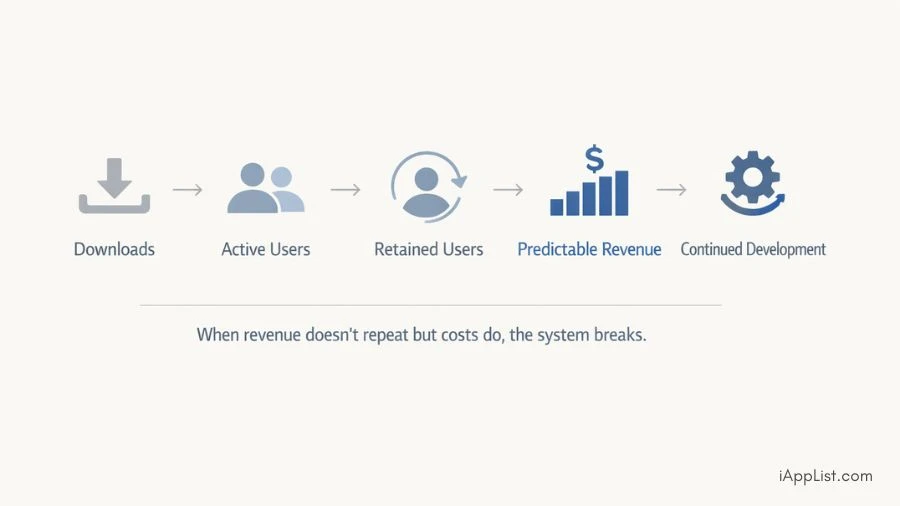
Each step depends on the one before it.
- Downloads alone don’t keep an app alive
- Active usage matters more than installs
- Retention determines whether revenue can repeat
- Predictable revenue determines whether development continues
If any part of this breaks, the app starts to decay.
Why One-Time Revenue Breaks the Equation
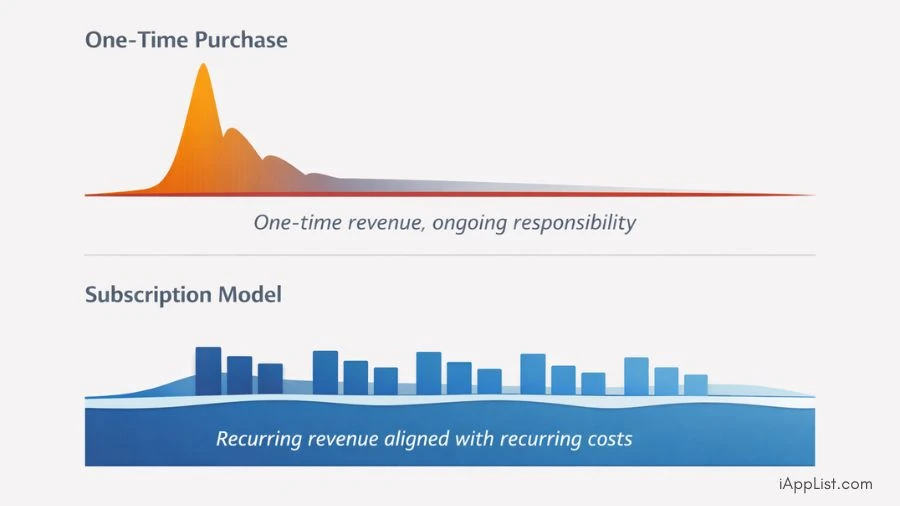
One-time purchases create a timing mismatch.
Revenue happens once.
Responsibility continues indefinitely.
As an app ages:
- new purchases slow down
- maintenance costs remain
- expectations increase
Without recurring income, developers are forced to choose between underfunding the app or abandoning it.
What Subscriptions Actually Solve
Subscriptions don’t guarantee success. They don’t magically increase profit.
What they do is align income with responsibility.
Recurring payments allow developers to:
- plan updates instead of reacting to spikes
- budget for support and infrastructure
- decide whether continued development is viable
In other words, subscriptions stabilize the equation.
Why This Model Spread So Quickly
Once a pricing model reliably keeps apps alive, it gets copied.
Not because it’s loved.
Because it works under pressure.
This is why subscriptions feel universal. They didn’t spread as a trend. They spread as a response to a system that punishes unpredictable revenue.
Read more: How App Store Rankings Actually Work (Based on Patterns, Not Claims)
2. When One-Time Purchases Quietly Stopped Working
For years, one-time purchases felt like the cleanest deal in apps. You paid once. You used the app. End of story.
What changed wasn’t user behavior. It was how apps themselves started to function.
The Hidden Costs Behind “Simple” Apps
Even the most basic app now carries ongoing responsibilities:
- Compatibility with new devices and screen sizes
- Yearly operating system updates that break old code
- Bug fixes and security patches
- Customer support and email handling
- Hosting, syncing, or background services
None of these costs stop after launch. They repeat.
A one-time payment covers the moment of purchase. It doesn’t cover the years that follow.
The Revenue Curve vs. The Responsibility Curve
This is where one-time pricing starts to fail structurally.
- Revenue spikes early, when an app is new or featured
- Revenue slows down over time, often sharply
- Responsibilities remain constant, or increase
In other words:
Income declines.
Work does not.
That gap grows wider every year.
Refunds Made Revenue Less Predictable
Platform refund policies introduced a quiet instability:
- Purchases can be reversed after use
- Income that looked final suddenly isn’t
- Small developers absorb the risk directly
For apps with thin margins, this unpredictability matters.
User Expectations Outgrew the Pricing Model
Over time, users began to expect:
- Regular updates
- Feature improvements
- Long-term support
- Compatibility with new OS versions
But one-time pricing never evolved to fund those expectations.
The result was a mismatch:
- Users expected ongoing value
- Developers were paid once
Why This Model Didn’t “Fail” — It Aged Out
One-time purchases didn’t disappear because people stopped liking them.
They disappeared because they stopped aligning with:
- how apps are maintained
- how platforms operate
- how long users expect apps to last
Subscriptions didn’t replace one-time pricing because they were better.
They replaced it because, for most apps today, the old model no longer matched reality.
3. The Platform Pressure Nobody Talks About
Most subscription discussions focus on what developers choose to do. What gets overlooked is what platforms quietly force them to adapt to.
Apps don’t operate in a vacuum. They operate inside app stores, and those environments shape nearly every pricing decision.
The Platform Cut Is Only the Beginning
App stores take a percentage of every transaction. That part is well known.
What’s less discussed is what comes with it:
- Fees apply to both new purchases and renewals
- Refunds can reverse revenue after delivery
- Developers don’t control the payment relationship
- Revenue arrives after delays, not instantly
For small teams, this turns pricing into a risk calculation, not just a business choice.
Discovery Isn’t Organic Anymore
Getting an app noticed used to rely heavily on charts and categories.
Today, visibility often depends on:
- Paid acquisition
- Promotional experiments
- Store feature volatility
- External traffic sources
In practical terms:
Building the app is no longer the most expensive part.
Getting users is.
Subscriptions help offset this by turning each acquired user into a longer-term revenue source rather than a one-time return.
Platform Rules Change Without Warning
Developers regularly have to adapt to:
- New privacy requirements
- API deprecations
- Design guideline changes
- Review policy shifts
These changes can:
- break existing features
- delay updates
- require unexpected rewrites
None of this comes with additional compensation.
The Risk Is Asymmetrical
This is an uncomfortable but important point.
- Platforms set the rules
- Platforms control distribution
- Platforms enforce compliance
- Developers absorb the cost
If something breaks, revenue stops immediately. Subscriptions don’t remove this risk, but they make it survivable.
Pricing Becomes a Defensive Decision
When platforms control access, payments, visibility, and refunds, pricing stops being purely about value.
It becomes about:
- predictability
- resilience
- continuity
Subscriptions emerge here not as an optimization, but as protection against uncertainty built into the system itself.
4. Why Subscriptions Feel Like They’re Everywhere Now
Subscriptions didn’t just become common. They became visible. What users notice isn’t the business model itself, but when and how it shows up.
That feeling of “every app does this now” comes from a handful of design and monetization patterns that repeat across categories.
Free First, Pay Later
Most modern apps remove payment from the moment of installation.
You’re allowed to:
- explore the interface
- try core features
- build a habit
Only after that does pricing appear.
This isn’t accidental. Delaying the paywall increases the chance that users experience value before being asked to commit. By the time pricing is shown, the app already feels familiar, and in some cases, necessary.
The Trial Normalized Everything
Free trials quietly reshaped expectations.
A 7-day or 14-day trial now functions less like a bonus and more like standard onboarding. From the developer’s perspective, trials reduce friction. From the user’s perspective, they blur the line between testing and paying.
That’s why so many subscriptions feel like they “start without warning.” The transition happens gradually, not at install.
Habit Before Monetization
Many apps wait for a specific moment before surfacing pricing:
- after a task is completed
- after progress is saved
- after usage crosses a threshold
The goal is simple: show the subscription after value has been demonstrated, not before.
This timing amplifies the sense that subscriptions are everywhere, because the paywall appears at moments when users are already engaged.
Retention Is the Real Product
What subscriptions optimize for isn’t conversion — it’s retention.
Once an app moves to a recurring model, the business focus shifts toward:
- daily or weekly engagement
- feature stickiness
- reminders and notifications
The result is that subscription-based apps tend to stay present in a user’s life longer, making the model feel more widespread than it actually is.
Why Cancellation Friction Exists
Subscription flows often make canceling less obvious than signing up. This is where frustration usually peaks.
From a system perspective, this friction exists because:
- short-term churn breaks revenue predictability
- early cancellations prevent recovery of acquisition costs
- retention metrics directly affect development decisions
This doesn’t excuse bad experiences, but it explains why friction shows up consistently across unrelated apps.
The Compounding Effect
When most apps follow the same patterns:
- delayed paywalls
- trials
- habit-based prompts
- recurring reminders
The result is psychological, not statistical.
Even if only a fraction of apps use subscriptions, they feel dominant because they occupy attention repeatedly over time.
That repetition is what makes subscriptions feel unavoidable.
5. Myths vs. Reality About App Subscriptions
By now, subscriptions are so common that a few assumptions tend to travel with them. Some sound reasonable. Others feel obvious. Most of them don’t fully hold up once you look at how apps actually operate.
This section separates what people assume from what’s usually happening underneath.
Myth 1: “Subscriptions make apps more profitable”
Reality: Subscriptions make revenue more predictable, not automatically higher.
A subscription doesn’t guarantee success. It spreads revenue out over time. Many apps earn less per user on a monthly plan than they ever did from one-time purchases, especially once platform fees, refunds, and churn are factored in.
What subscriptions offer is planning ability. Predictable income allows developers to decide whether they can afford continued updates, support, or even keeping the app alive at all.
Myth 2: “Developers prefer subscriptions”
Reality: Most developers prefer sustainability.
Subscriptions introduce their own problems:
- constant pressure to retain users
- higher expectations for ongoing updates
- backlash from users who dislike recurring payments
For many teams, subscriptions aren’t a first choice. They’re the option that best aligns recurring costs with recurring income under platform constraints.
Myth 3: “Users are being tricked into paying”
Reality: The system optimizes for delayed decisions, not deception.
Free trials, delayed paywalls, and habit-based prompts are designed to reduce friction and increase conversion. That can feel manipulative, especially when cancellation isn’t obvious.
But the intent, structurally, is to let users experience value before pricing becomes relevant. Whether that execution feels fair often depends on how transparent the app is, not on the subscription model itself.
Myth 4: “Canceling doesn’t really matter”
Reality: Early cancellations directly affect how apps evolve.
Retention metrics influence:
- feature prioritization
- update frequency
- staffing decisions
- whether the app continues at all
When users cancel quickly, developers don’t just lose revenue. They lose confidence in future investment. This is one reason apps push so hard for the first few weeks of engagement.
Myth 5: “Only big apps benefit from subscriptions”
Reality: Subscriptions often matter more for small, niche apps.
Large apps can offset losses with scale. Smaller apps can’t.
For niche tools with limited audiences, even a modest number of long-term subscribers can be the difference between continued development and abandonment. In those cases, subscriptions function less as optimization and more as survival.
The Pattern Behind All of These Myths
Most misconceptions come from treating subscriptions as a moral choice rather than a structural response.
When recurring costs, platform fees, discovery pressure, and user expectations all move in the same direction, pricing models tend to follow. Subscriptions didn’t spread because everyone agreed they were ideal. They spread because, under modern conditions, fewer alternatives remained viable.
6. The Subscription Funnel (How Apps Actually Monetize)
Most apps don’t push subscriptions randomly. They follow a fairly consistent sequence that’s been refined across categories, platforms, and years of experimentation.
This isn’t a conspiracy. It’s a funnel.
Step 1: Acquisition Comes First
The first goal is always to remove friction at install.
That’s why many apps:
- avoid showing prices upfront
- emphasize “free” in store listings
- highlight immediate utility over long-term cost
At this stage, the app isn’t trying to make money. It’s trying to get in the door.
Step 2: Prove Value Quickly
Once installed, the focus shifts to speed.
Apps are designed to show a meaningful result as early as possible:
- a completed task
- a visual output
- a sense of progress
This early success creates momentum. The app starts to feel useful before any payment decision is required.
Step 3: Introduce the Paywall at the Right Moment
The paywall usually appears after value has already been demonstrated.
Common triggers include:
- saving or exporting something
- reaching a usage limit
- unlocking advanced features
The timing matters more than the price. A well-timed paywall converts better than an aggressive one.
Step 4: Convert With Minimal Commitment
Monthly plans, trials, and discounts exist to lower psychological resistance.
A small recurring number feels easier to accept than a large one-time cost, especially when framed as:
- “cancel anytime”
- “risk-free trial”
- “less than a coffee per week”
This is where subscriptions quietly outperform purchases.
Step 5: Retention Becomes the Product
Once a user subscribes, the app’s priorities change.
The business now depends on:
- continued engagement
- perceived ongoing value
- avoiding early cancellation
This is why subscribed users often see:
- more reminders
- nudges to return
- feature updates framed as improvements
Retention isn’t just a metric. It’s the foundation of the model.
Why This Funnel Feels So Familiar
The reason subscriptions feel “everywhere” isn’t because every app is identical.
It’s because this funnel works.
Once a structure consistently improves conversion and survival, it spreads. Apps copy what keeps other apps alive. Over time, the patterns become recognizable — not because users are targeted, but because the system rewards repetition.
7. Why Even Simple Apps Use Subscriptions
This is usually where frustration peaks.
A calculator. A timer. A scanner.
Something that feels like it should have been a one-time purchase, or free forever.
So why does it still ask for a subscription?
“Simple” on the Surface, Ongoing Underneath
What looks simple to the user often isn’t simple to maintain.
Even minimal apps still require:
- updates for new operating system versions
- testing across devices and screen sizes
- bug fixes triggered by platform changes
- customer support, even at low volume
The interface may not change much. The maintenance never stops.
Niche Apps Don’t Have Scale
Many simple apps serve small, specific audiences.
That means:
- fewer total downloads
- limited growth potential
- no room to rely on volume
When an app has tens of thousands of users instead of millions, one-time pricing dries up quickly. A subscription model allows a small group of engaged users to support continued development.
Support Costs Don’t Scale Down
Support is one of the most underestimated costs in app development.
Even a basic app generates:
- email questions
- bug reports
- refund requests
- compatibility issues
These don’t disappear just because the app is small. Subscriptions help justify spending time on support that otherwise wouldn’t be economically viable.
One-Time Pricing Creates a Slow Exit
For simple apps, one-time pricing often leads to a familiar pattern:
- early sales during launch
- declining revenue over time
- fewer updates
- eventual abandonment
Subscriptions change that trajectory by tying ongoing work to ongoing income.
When Subscriptions Are About Survival, Not Upselling
Not every subscription is reasonable. Some are clearly overreaching.
But in many cases, especially for niche or utility apps, subscriptions exist because:
- the audience is small
- the expectations are ongoing
- the costs repeat
In those situations, recurring pricing isn’t about maximizing profit. It’s about making sure the app doesn’t quietly disappear.
8. Who Subscriptions Actually Benefit (And Who They Hurt)
Subscriptions don’t affect everyone the same way. Whether they feel fair or frustrating depends a lot on where you’re standing in the system.
Looking at them through a single lens misses most of the story.
Indie Developers
For small teams and solo developers, subscriptions often provide something one-time purchases never did: stability.
A modest number of long-term subscribers can fund:
- ongoing maintenance
- customer support
- slow, careful feature development
Without recurring income, many indie apps end up frozen in time or abandoned altogether. In that sense, subscriptions can be the difference between an app existing and disappearing.
At the same time, subscriptions raise expectations. Users expect regular updates, faster responses, and visible progress. For small teams, that pressure can be intense.
VC-Backed Startups
For venture-funded apps, subscriptions align neatly with growth metrics.
Recurring revenue is easier to model, pitch, and scale. It supports paid acquisition and expansion strategies that wouldn’t make sense with one-time pricing. In these environments, subscriptions aren’t just a business model — they’re an expectation.
The downside is that growth pressure can lead to aggressive retention tactics and pricing experiments that frustrate users, especially when value doesn’t scale with cost.
Power Users vs Casual Users
Subscriptions tend to favor people who use an app frequently.
For power users, paying monthly or annually can feel fair, even economical. They extract ongoing value and benefit from continuous updates.
Casual users experience the opposite. Paying repeatedly for something they use occasionally feels inefficient. This is where frustration and “subscription fatigue” usually set in.
The Platform Itself
Platforms benefit from subscriptions in a quieter way.
Recurring payments:
- smooth platform revenue
- increase lifetime value per user
- reduce dependence on spikes
Because platforms take a percentage of every renewal, long-term subscriptions generate predictable income without additional distribution effort.
Why There’s No Universal Winner
Subscriptions aren’t inherently good or bad. They redistribute risk.
Developers trade volatility for pressure.
Users trade ownership for access.
Platforms trade neutrality for predictability.
Whether that trade feels fair depends on the app, the pricing, and how transparently the relationship is handled.
9. How Subscription Fatigue Is Changing App Pricing
As subscriptions became the default, user tolerance started to shift. The result hasn’t been a rejection of subscriptions altogether, but a gradual pushback that’s already influencing how apps price themselves.
The changes are subtle, but they’re real.
Annual Plans Became the Real Price
Monthly subscriptions still exist, but they’re increasingly positioned as the least attractive option.
Many apps now:
- price monthly plans high
- offer large discounts on annual billing
- frame yearly plans as the “best value”
This isn’t just marketing. Annual subscriptions reduce churn and platform fees over time, making revenue easier to predict while giving users a sense of commitment rather than constant re-evaluation.
Lifetime Deals Quietly Returned
For years, lifetime pricing all but disappeared.
Now it’s resurfacing — selectively.
Lifetime options tend to show up:
- in niche apps
- as limited-time offers
- alongside subscriptions, not instead of them
These deals provide immediate cash flow while still allowing developers to rely on subscriptions for long-term sustainability.
Bundling as a Pressure Release Valve
Another response to fatigue is bundling.
Instead of charging separately for multiple tools, some apps now offer:
- all-in-one subscriptions
- cross-feature access
- expanded toolsets under a single plan
Bundling reframes the subscription as access rather than obligation, which feels easier to justify psychologically.
More Transparency, Not Less
Apps facing backlash often respond by changing how pricing is presented rather than removing subscriptions entirely.
Clearer onboarding, better explanations of limits, and upfront comparisons between free and paid tiers are becoming more common. When users understand what they’re paying for, frustration tends to drop — even if the price stays the same.
The Model Is Adjusting, Not Collapsing
Subscription fatigue hasn’t killed recurring pricing. It’s refined it.
Apps are learning that:
- aggressive pricing hurts trust
- unclear limits increase churn
- perceived fairness matters as much as features
What’s emerging now isn’t a rejection of subscriptions, but a quieter negotiation between users and developers about what feels reasonable.
10. Why Subscriptions Aren’t Going Away (Even If Users Hate Them)
Subscription fatigue is real. Frustration is real.
But neither of those forces is strong enough, on its own, to reverse the model.
The reason is structural.
Predictable Revenue Is Hard to Replace
Subscriptions solve one problem better than almost any alternative: uncertainty.
Recurring revenue allows developers to:
- forecast income
- plan updates
- decide whether an app can continue at all
One-time purchases spike and fade. Ads fluctuate. Sponsorships are unreliable. Subscriptions may be unpopular, but they remain the most stable option available under current platform conditions.
Operating Costs Don’t Pause
Apps don’t get cheaper to run over time.
Infrastructure, support, and maintenance continue whether usage grows or shrinks. Annual operating system updates often increase workload, not reduce it. Any model that doesn’t account for recurring costs eventually breaks down.
Investor Expectations Lock the Model In
For VC-backed apps, subscriptions are no longer just preferred — they’re expected.
Recurring revenue fits neatly into growth forecasts, valuation models, and fundraising narratives.
Shifting away from subscriptions would require changing how success is measured, not just how pricing works.
Platform Incentives Reinforce the Status Quo
Platforms benefit from recurring payments.
They:
- smooth revenue
- increase lifetime value per user
- reduce dependence on seasonal spikes
As long as platforms reward predictable income, developers will feel pressure to align with it.
What Would Actually Need to Change
Subscriptions aren’t inevitable by nature. They’re inevitable under current conditions.
Meaningful change would require:
- lower platform fees
- different discovery mechanics
- more flexible payment models
- clearer ownership options
Until those shift, subscriptions remain the least fragile option available.
Why Pushback Still Matters
User frustration isn’t irrelevant. It shapes how subscriptions are implemented, even if it doesn’t eliminate them.
That’s why we’re seeing:
- better transparency
- alternative pricing experiments
- more consumer-friendly retention practices
The model isn’t disappearing. It’s being negotiated.
11. What Users Can Do (Without Gaming the System)
Understanding why subscriptions exist doesn’t mean you have to like them.
But it does give you leverage — not to outsmart the system, but to use it more intentionally.
This is where small decisions actually make a difference.
Treat Subscriptions as Ongoing Relationships
A subscription isn’t a purchase. It’s a commitment.
Before subscribing, it helps to ask:
- Do I use this often enough to justify recurring cost?
- Would my workflow actually break without it?
- Am I paying for convenience or necessity?
This mental shift alone filters out a surprising number of impulse sign-ups.
Monthly vs Annual Isn’t Just About Price
Annual plans are usually cheaper, but they’re not always better.
Monthly plans make sense when:
- usage is temporary
- value is still unclear
- your needs might change
Annual plans make sense when:
- the app is already embedded in your routine
- switching costs are high
- long-term value is obvious
Choosing the wrong billing cycle is one of the fastest ways to feel subscription fatigue.
Use Trials Intentionally
Trials work best when treated as evaluation periods, not free access.
That means:
- testing the features you’d actually pay for
- paying attention to friction and limits
- noticing how often you naturally return to the app
If you’re not reaching for it during the trial, you probably won’t after.
Track What You’re Paying For
Subscription creep happens quietly.
A periodic review — even once every few months — helps surface:
- forgotten subscriptions
- overlapping tools
- apps that no longer justify their cost
Canceling unused subscriptions isn’t punishing developers. It’s aligning spending with actual value.
Support the Apps You Truly Rely On
For apps that genuinely matter — tools you use daily or weekly — subscriptions can be a form of support.
Consistent payment:
- funds maintenance
- encourages continued development
- keeps niche tools alive
Being selective doesn’t mean being stingy. It means being intentional.
Canceling Isn’t a Statement — It’s Feedback
Canceling a subscription isn’t an attack on the app or the developer.
It’s data.
Retention signals shape:
- pricing experiments
- feature priorities
- future direction
Staying subscribed out of guilt helps no one. Paying for value does.
12. What This Means for the Future of Apps
The shift to subscriptions didn’t just change how apps charge. It changed what apps are allowed to be.
As the economics tightened, the app ecosystem began filtering itself.
Fewer Disposable Apps, More Serious Tools
When ongoing revenue becomes necessary, short-lived or novelty apps struggle to survive.
The apps that last tend to be:
- tools people rely on repeatedly
- services with clear, ongoing value
- products that justify maintenance over time
This doesn’t mean creativity disappears, but it does mean experimentation carries higher risk.
Higher Expectations on Quality and Transparency
As users pay continuously, tolerance for half-finished experiences drops.
Subscriptions raise the bar. People expect:
- stability
- regular improvements
- clear communication about limits and pricing
Apps that can’t meet those expectations face faster churn and public backlash.
More Pressure to Consolidate
Subscription fatigue encourages consolidation.
Instead of paying for many narrow tools, users gravitate toward:
- all-in-one platforms
- bundled feature sets
- services that replace multiple apps
This trend favors larger products while forcing smaller apps to differentiate more sharply.
Pricing Innovation Will Continue at the Edges
While subscriptions dominate, alternatives aren’t gone.
We’re likely to keep seeing:
- limited lifetime options
- usage-based pricing
- hybrid free + paid models
These experiments won’t replace subscriptions broadly, but they’ll shape how flexible the model becomes.
The System, Not the Sentiment, Will Decide
User frustration influences design and transparency.
Economics determines survival.
Unless platform incentives change — fees, discovery, or payment flexibility — subscriptions will remain central, even as the details evolve.
The future of apps isn’t subscription-free.
It’s negotiation-driven.
Final Take: This Isn’t About Greed — It’s About Survival
It’s easy to frame subscriptions as a moral failure. They’re visible, repetitive, and often frustrating. But when you step back and look at the system as a whole, a different picture emerges.
Apps didn’t move to subscriptions because it was the most elegant solution. They moved because, under modern platform economics, it was often the least fragile one. Costs repeat. Rules change. Discovery isn’t guaranteed. In that environment, revenue that shows up once and disappears rarely sustains anything for long.
That doesn’t make every subscription fair. Some are poorly priced. Some are badly explained. Some ask for more than they deliver. User frustration is justified, especially when transparency is missing or cancellation feels deliberately obscure.
But treating subscriptions as a conspiracy misses the more important point. They’re a response to pressure, not the source of it.
Understanding that difference matters. It helps users make better choices. It helps writers explain the landscape without flattening it. And it helps developers see that trust, clarity, and restraint still matter, even within a flawed system.
Subscriptions aren’t going away. But how they’re used, explained, and justified is still very much up for negotiation.
And that negotiation is where the future of apps will be decided.